ACNH Farm Ideas: 9 Crop, Barn, and Country Build Layouts
The best ACNH farm ideas are planned as working island zones, not just a pretty field of crops. This guide breaks a farm into crop rows, a home or barn focal point, orchard edges, paths, markets, and flexible space so you can test the route in the planner before moving buildings or rebuilding terrain.
What is the best way to plan an ACNH farm?
Start with the farm's daily route. A useful ACNH farm layout gives you a clear way to enter the crop area, walk between rows, reach storage or a home, and leave room for an orchard, market, or future expansion. The field itself is only one part of the build.
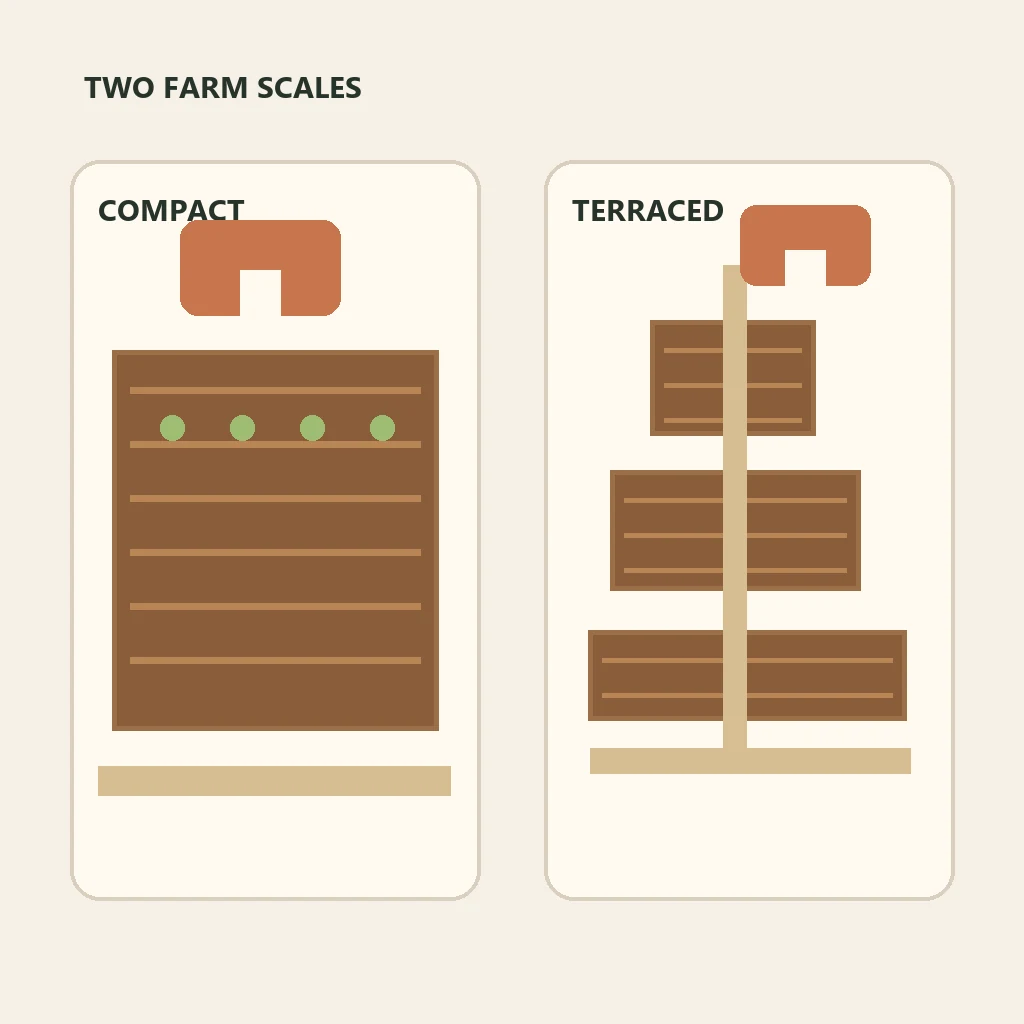
For most islands, a compact rectangular field is the easiest first version. Place the farmhouse, barn-style building, or market at one edge, keep the main path wider than the crop aisles, and reserve one empty strip so the farm can grow without forcing a full redesign.
- Mark rivers, beaches, cliffs, and building footprints before decorating.
- Choose one farm focal point: crop field, farmhouse, orchard, or market.
- Use paths and fence openings to make the zone feel practical, not boxed in.
- Test a compact version first, then expand only after the route feels comfortable.
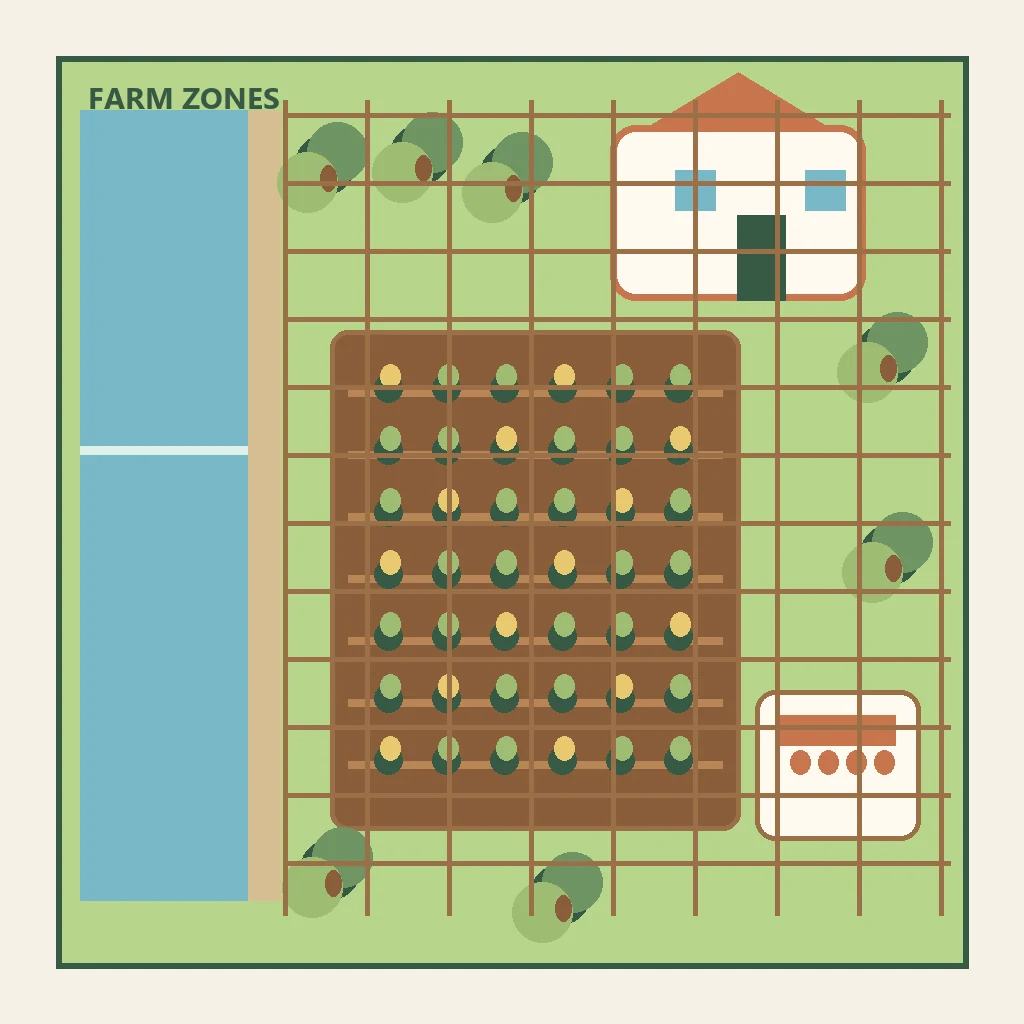
Start with the farm zone, not the decorations
A farm becomes easier to build when you separate fixed features from flexible decoration. Use the ACNH island planner template to mark the river, beach, Resident Services direction, and any buildings that cannot move into your preferred farm area. Then sketch the field and routes before choosing fences, stalls, or custom paths.
If you are working with a tight island, borrow the zone-first approach from the island planning guide: give the farm a job, decide what should be visible from the main route, and keep one edge open for later changes.
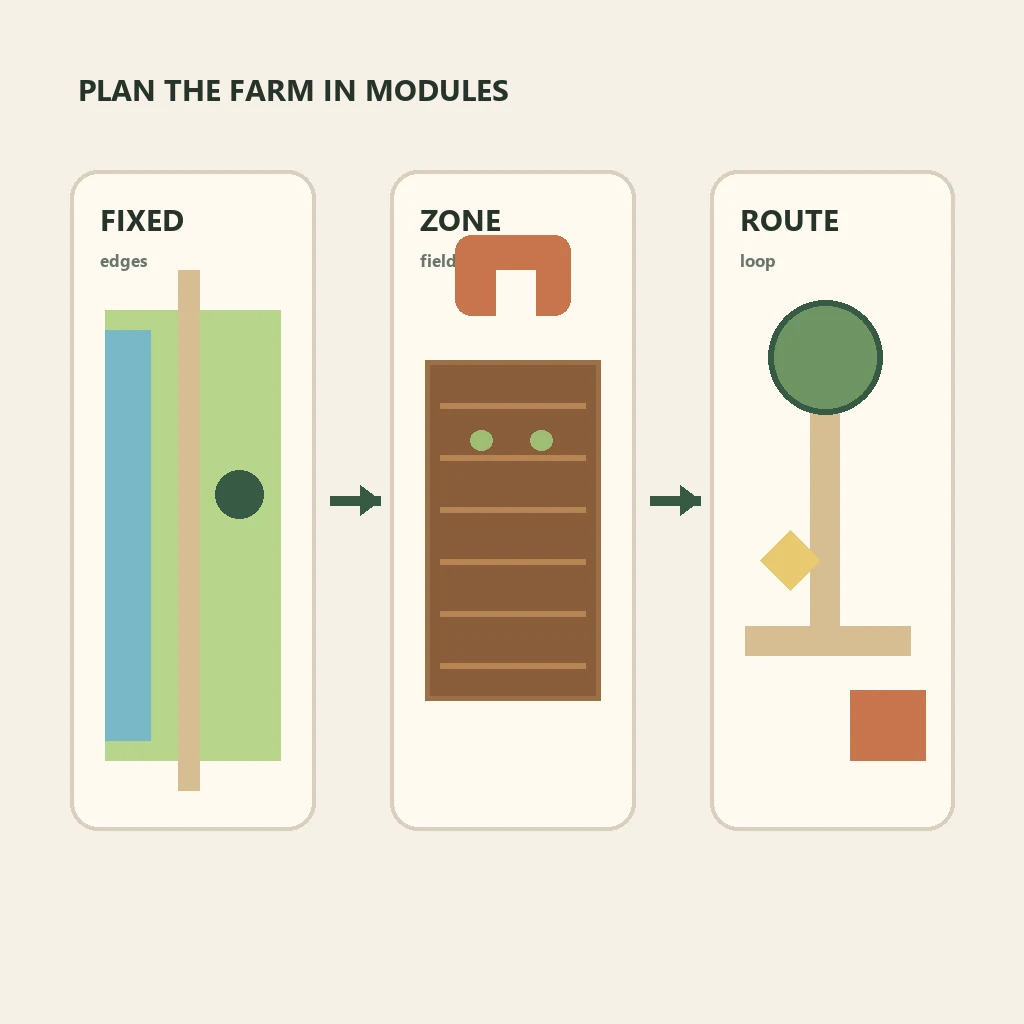
- Mark fixed edges. Trace rivers, beaches, cliffs, bridges, inclines, and building footprints. These edges determine whether the farm should be compact, linear, or terraced.
- Pick the focal point. Choose a crop field, farmhouse, orchard, market, or silo-style prop as the visual anchor. Do not give every small area equal detail.
- Draw the working route. Connect the entrance, storage, home, crop rows, water source, and exit with a path that still works when the zone is decorated.
- Reserve expansion space. Leave a blank strip for more crops, a second field, a seasonal stand, or a small orchard so the first version does not become a dead end.
9 ACNH farm ideas you can actually build
Use these layouts as starting modules. Each one has a different space requirement and route, so choose the shape that matches your island before copying the decoration style.
1. Compact crop square
A tidy field beside a home or storage point, with one main path and a small fence opening.
- Best for
- Small flat spaces and beginner builds.
- Planner setup
- Reserve a rectangle with one path on the long side and a two-tile service strip.
- Build note
- Keep the field readable from the route; use one crop palette instead of filling every tile.
2. Farmhouse and front yard
A home becomes the anchor while crops sit behind it and a short garden path frames the entrance.
- Best for
- Cottagecore, country, and storybook islands.
- Planner setup
- Place the home at the front edge, then give the crop rows a direct visual axis behind it.
- Build note
- Use a small porch, mailbox area, and fence gate to create a clear transition from island path to farm.
3. Orchard-to-field transition
Fruit trees form a soft border between the farm and a larger natural or forest zone.
- Best for
- Natural islands that need a gradual change of texture.
- Planner setup
- Reserve a tree row with enough walking width for harvesting and a path that continues behind it.
- Build note
- Avoid a solid wall of trees; stagger the edge so the field still feels connected to the island.
4. River-edge market farm
A narrow field follows a river, then opens into a produce stall or seasonal market near the bridge.
- Best for
- Islands with a strong river bend or a busy central route.
- Planner setup
- Use the river as one boundary and keep the opposite side straight enough for a service path.
- Build note
- Place the market at the route junction so it feels like a destination rather than a blocked walkway.
5. Cliffside terraced farm
Three smaller crop beds step up a cliff, creating a layered countryside view instead of one large field.
- Best for
- Scenic islands and players who enjoy controlled terraforming.
- Planner setup
- Draw each terrace separately and align the stairs or ramp with the main route.
- Build note
- Keep at least one practical route to every terrace; scenery should not turn the farm into a maze.
6. No-terraforming field strip
A long, narrow farm uses existing flat land, fences, trees, and paths without changing cliffs or rivers.
- Best for
- Fresh islands, redesigns with limited time, and low-risk planning.
- Planner setup
- Follow the existing terrain and let the long edge carry the main path and storage access.
- Build note
- Break the strip with one rest area or tree cluster so it does not feel like a corridor of crops.
7. Barnyard and tool corner
A smaller crop patch sits beside a work area for tools, wood, baskets, and rustic props.
- Best for
- Detailed country builds with a strong work-in-progress story.
- Planner setup
- Group the field, work corner, and home around one loop rather than several dead-end paths.
- Build note
- Leave the center of the loop open for movement and use props around the edges as punctuation.
8. Farm-to-market street
The farm feeds a short street of stalls, a cafe, or a village square so the harvest zone connects to daily play.
- Best for
- Urban-rural contrast and islands with a town theme.
- Planner setup
- Put the field at one end, the market in the middle, and the wider town route at the other end.
- Build note
- Use a consistent path width so the change from dirt lane to town street feels intentional.
9. Seasonal farm test plot
A flexible empty plot changes with the season: crops, flowers, pumpkins, a festival stand, or a picnic scene.
- Best for
- Players who update their island often or want one reusable content zone.
- Planner setup
- Reserve a simple rectangle with utility paths and avoid permanent cliffs around it.
- Build note
- Keep the surrounding palette neutral so different seasonal decorations still fit the island.
A simple farm planning workflow
The fastest way to compare ACNH farm layouts is to test the same farm job in different shapes. In the planner, keep the crop field roughly consistent, then change the route, edge, or focal point. This makes it easier to see whether the problem is the idea or the space.
The table below is a practical order of operations. It also keeps a farm from expanding into the main daily route before you know how much space the build really needs.
| Farm area | Reserve first | What to test |
|---|---|---|
| Crop field | Rows, aisles, and one service edge | Can you enter, turn, and leave without crossing the beds? |
| Home or barn | Footprint, front path, and one side yard | Does the focal point face the route instead of a cliff or wall? |
| Orchard | Tree spacing and harvesting path | Can you walk through it without creating a solid visual barrier? |
| Market | Stalls, bridge, and main junction | Does it feel like a destination without narrowing the daily route? |
| Expansion strip | One blank edge with no permanent obstacle | Can the farm grow without moving the first field? |
Choose a farm layout by island space
The right farm idea depends less on the number of decorations and more on the shape of the land you can protect for the route.
If your island has little flat land
Choose the compact square, farmhouse yard, or no-terraforming strip.
- Keep one field and one focal point.
- Use fences as a boundary, not a maze.
- Save the orchard or market for a later extension.
If you have a river or cliff edge
Choose the river market, orchard transition, or terraced farm.
- Let the fixed edge provide the visual shape.
- Check bridges, ramps, and turning space first.
- Break long edges with a path opening or rest area.
If you want a flexible update zone
Choose the seasonal test plot or farm-to-market street.
- Keep the background palette quiet.
- Avoid permanent terraforming around the plot.
- Make the route useful even when the decorations change.
Crop fields, orchards, and market details
Farm inspiration often overlaps with other ACNH build searches. Keep the page focused on a farm as a connected zone, then send narrower tasks to the most relevant guide instead of turning this article into a general item database.
For flower beds used as decoration rather than crop production, link to the ACNH flower breeding guide. For a broader theme, compare the farm with the island ideas guide; for exact building and path placement, use island layout ideas.
Crop field layout
Use repeated rows for a farm that reads clearly from above, then add one service aisle wider than the crop gaps.
- Start with one field size before adding a second.
- Place the access path on the edge, not through every row.
- Keep an empty tile or strip for future changes.
Orchard and garden edge
Trees, flowers, and hedges soften the field boundary, but a farm needs openings so the edge does not become a wall.
- Stagger trees instead of making a solid line.
- Use a path or stream to explain the transition.
- Move finished flower hybrids into the farm edge only after testing the route.
Produce market
A small market gives the farm a destination and helps connect the build to a village, cafe, bridge, or plaza.
- Put the market beside a junction, not in the only through-route.
- Leave space behind stalls for walking and seasonal changes.
- Use one or two repeated materials to keep the area readable.
Country details
Fences, dirt paths, wood piles, tools, barrels, and a farmhouse can tell the story without filling every tile.
- Give each prop a relationship to a path or work area.
- Leave quiet grass around the focal point.
- Use the planner to check the silhouette before decorating.
ACNH farm planning checklist
Run this checklist before you move a building, raise a cliff, or fill the field with decorations.
Fixed features
- River, beach, cliff, bridge, and ramp locations are marked.
- The route to the farm does not cut through a key daily shortcut.
- Home, storage, market, and field footprints fit the reserved space.
- At least one expansion edge stays flexible.
Working route
- The main path is easy to recognize.
- Crop rows have an access point and turning space.
- Fence gates do not create dead ends.
- The farm still feels comfortable when viewed from both directions.
Decoration pass
- One focal point is stronger than every surrounding detail.
- Tree, flower, and fence colors support the island theme.
- The market or farmhouse has breathing room.
- You have tested the zone before committing to heavy terraforming.
Common ACNH farm layout mistakes
A farm can look attractive in a screenshot and still feel awkward to use. These are the problems worth checking before the build spreads across the island.
- Making the field too large first. A huge crop grid leaves no room for a route, home, orchard, or market. Prove the smaller version before expanding.
- Closing every edge with fences. Fences define the farm, but too many gates and corners create a maze. Keep one clear visual and walking opening.
- Ignoring the route outside the farm. The farm should connect to the island's daily loop. If it only works as a destination, visitors and routine tasks will feel inconvenient.
- Copying a flat layout onto a cliff map. A terraced or river-edge version may fit your island better than forcing a perfect rectangle into an awkward space.
- Decorating before testing the footprint. Heavy props make changes expensive. Save the clean plan, test the route, and add detail in layers.
Useful references for an ACNH farm build
These references help separate farm layout inspiration from broader planning and game context. The images on this page are editorial diagrams, not copied screenshots.
- ACNH Island Ideas - Use this for the wider island theme and zone mix around the farm.
- ACNH Island Layout Ideas - Use this when the farm needs a stronger map, route, or building placement pattern.
- Nintendo: Animal Crossing: New Horizons - Official game reference; this article is an unofficial fan-made planning guide.
- GamesRadar: ACNH farm layout inspiration - External editorial inspiration reviewed for common farm-build patterns; no screenshot is reproduced here.
- Community farm inspiration on Reddit - User-generated inspiration only; community material is not presented as official.
ACNH farm ideas FAQ
What are the best ACNH farm ideas for a small island area?
Start with a compact crop square, a farmhouse front yard, or a no-terraforming field strip. One clear field, one service path, and one focal point usually look more intentional than a large farm squeezed into a narrow space.
How much space should I reserve for an ACNH farm?
Reserve the field, access path, focal building, and at least one expansion edge before decorating. The exact footprint depends on your map, but planning the route first prevents the crop rows from taking every usable tile.
Can I build an ACNH farm without terraforming?
Yes. Follow an existing flat strip, river edge, or beach-side boundary and use paths, trees, and fences to define the zone. A no-terraforming farm is often the safest first version because it is easier to change later.
Does snow water crops in Animal Crossing?
Do not plan the farm around snow as a reliable watering shortcut. Treat seasonal weather as atmosphere and keep the layout useful without assuming it will replace your normal crop-care routine.
How do I connect a farm to the rest of my ACNH island?
Give the farm one visible entrance and connect it to a daily route, bridge, market, village street, or orchard path. Keep the main route wider than the crop aisles and avoid placing the market in a necessary shortcut.
Should I use a crop field, orchard, or market as the focal point?
Choose the element that best matches your available space. A crop field works in a flat rectangle, an orchard softens a natural edge, and a market works best where a farm route meets a bridge, village, or plaza.
Test Your Farm Layout Before You Build
Mark the fixed edges, place the crop field, connect the route, and save a version before moving buildings or committing to terraforming.
Open the Free ACNH Island Planner